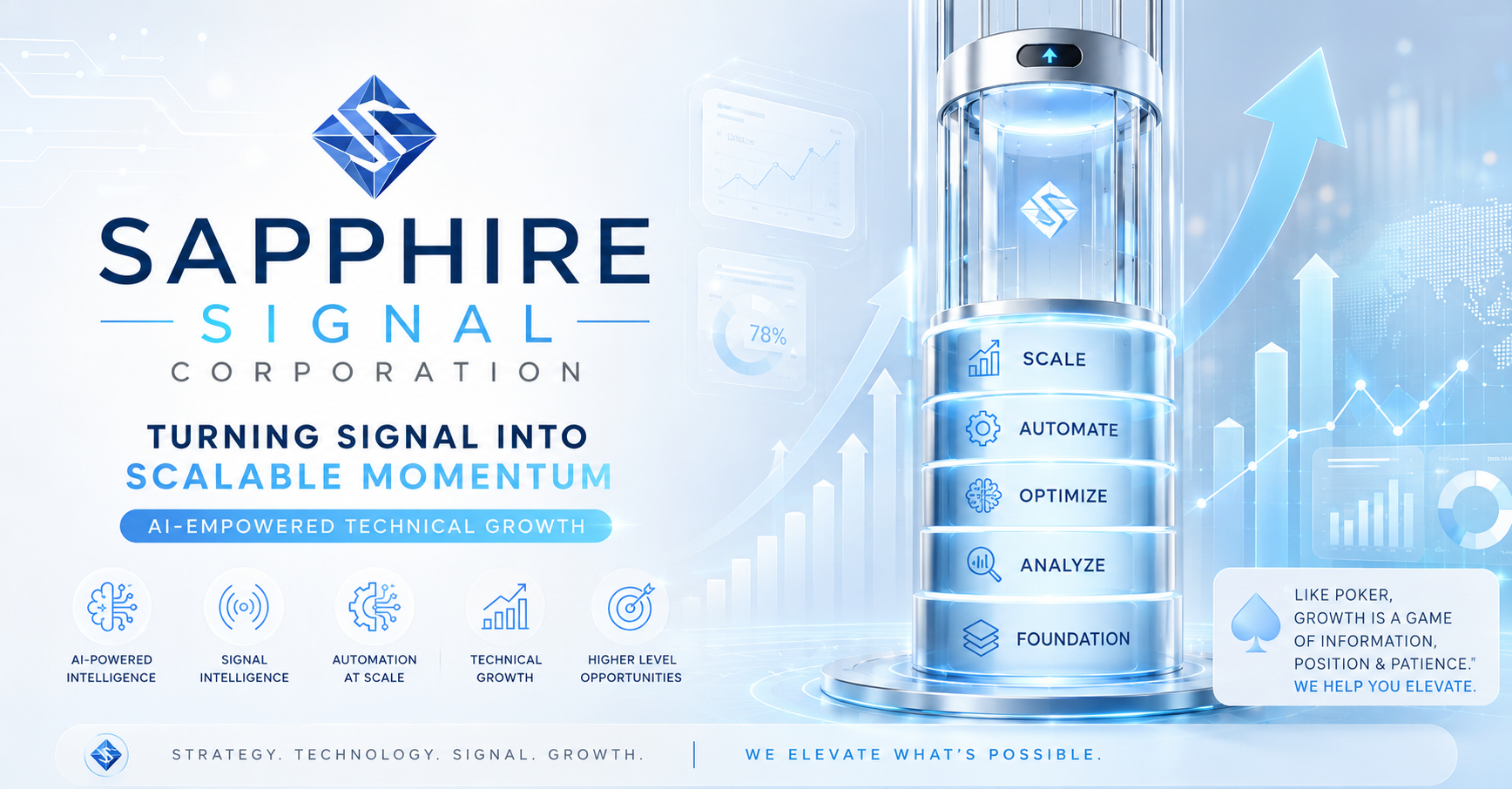
Poker Taught Me Something Important About Business Growth
Poker tournaments reveal an important truth about elevation, pressure, and momentum.
In a tournament, the blinds are forced to rise over time. Every player is eventually pressured into moving upward or being eliminated. Survival is not enough. You have to adapt, protect your stack, pick the right moments, and eventually play bigger than you were comfortable playing at the beginning.
The reward for surviving that pressure is a concentrated payout at the top.
But the deeper realization is this:
You can recreate this same “elevator” structure voluntarily in cash games.
Every time you consistently win at one blind level, you move yourself to the next.
From:
- $1/$2 to $2/$5
- $2/$5 to $5/$10
- $5/$10 to $25/$50
Instead of waiting for the structure to force growth, you intentionally elevate yourself upward through discipline, skill, bankroll management, adaptability, emotional control, and confidence.
Business works the same way.
Every successful project, relationship, automation, referral, partnership, technical audit, or operational improvement becomes a bankroll increase. It gives you the credibility and confidence to enter a larger arena with stronger players and bigger opportunities.
I’ve started thinking about this concept as:
Elevators.
The Elevator philosophy is self-directed blind escalation.
It means continuously moving yourself into larger games by creating value, surviving pressure, compounding momentum, and earning the right to play at the next level.
And with AI changing the economics of software development, consulting, automation, and technical sales, this model becomes even more powerful.
The Future of Consulting Is Not Selling Labor
Most consulting companies still operate from an old model.
They sell:
- developer hours,
- temporary technical help,
- isolated deliverables,
- websites,
- or disconnected project work.
But AI is changing the economics of execution.
Historically, scaling a consulting company required more developers, more project managers, more overhead, more meetings, and more operational complexity.
Today, a small technical team equipped with AI can create leverage that previously required a much larger organization.
A lean AI-empowered team can now:
- generate prototypes rapidly,
- automate internal workflows,
- document systems faster,
- analyze infrastructure,
- create technical audits,
- build sales enablement assets,
- produce architecture diagrams,
- generate marketing content,
- accelerate development,
- and create enterprise-grade solutions with greater speed.
This changes the consulting game.
The modern consulting company is no longer just a development shop.
It becomes:
- a leverage engine,
- a signal amplifier,
- a systems builder,
- a technical growth partner,
- and an operational accelerator.
That is the foundation behind Sapphire Signal Corporation.
The goal is not simply to build software.
The goal is to identify business pressure, detect opportunity, translate complexity into strategy, and use AI-empowered execution to help companies move faster.
Signal Is the New Sales Advantage
The word “signal” matters.
In business, signal is everywhere.
A company hiring five developers is sending a signal.
A slow website is sending a signal.
A broken checkout flow is sending a signal.
A public job posting for a Magento developer, React engineer, DevOps architect, PHP developer, AI automation specialist, or cloud infrastructure lead is sending a signal.
A company struggling with growth, technical debt, performance, automation, or modernization is usually revealing that need before a formal sales conversation ever happens.
Most people look at job boards and see employment opportunities.
A consulting company should also see business intelligence.
Job postings reveal:
- budget,
- urgency,
- growth pressure,
- technology stack,
- operational pain,
- internal bottlenecks,
- and strategic priorities.
The opportunity is not to exploit that information.
The opportunity is to respond intelligently.
Instead of chasing companies with generic sales pitches, a modern consulting company can build a technical opportunity intelligence pipeline.
That means identifying companies with active technical needs, studying their stack, understanding their likely pain points, and approaching them with useful insight.
Not spam.
Not deception.
Not pressure.
Value.
A performance audit.
A technical debt scorecard.
A migration recommendation.
An AI automation idea.
A DevOps improvement.
A checkout optimization.
A cloud cost reduction opportunity.
A roadmap.
That is how technical sales becomes consultative instead of transactional.
Capability Positioning Assets
The smartest strategy is not aggressive selling.
It is positioning.
Enterprise trust is rarely built from one cold message.
It is built through proof.
That proof comes from what I call:
Capability Positioning Assets.
These are assets designed to demonstrate technical strength, business understanding, and strategic thinking before the first sales call ever happens.
Examples include:
- polished consultant profiles,
- technical case studies,
- architecture diagrams,
- performance audits,
- AI automation demos,
- migration playbooks,
- infrastructure reviews,
- DevOps workflow examples,
- Shopify and Magento optimization reports,
- Core Web Vitals breakdowns,
- API integration examples,
- Stripe implementation examples,
- and niche landing pages focused on specific business problems.
These assets operate like silent salespeople.
They build credibility before the conversation.
They communicate competence before the pitch.
They show the client that you understand their pain before they have to explain it.
In the AI era, producing these assets becomes dramatically faster and more scalable.
That creates a major advantage for small, focused, technically credible firms.
Productized Consulting Creates the Elevator
One of the biggest mistakes small consulting companies make is offering everything to everyone.
That creates confusion.
A stronger model is productized consulting.
For Sapphire Signal, that means creating clear service tiers that match different levels of client risk, urgency, and budget.
For example:
Signal Starter
For small businesses that need immediate technical improvement.
This could include:
- website audits,
- performance optimization,
- basic AI automation,
- CRM setup,
- landing page improvement,
- analytics cleanup,
- and conversion-focused technical fixes.
Growth Infrastructure
For scaling businesses with operational and technical bottlenecks.
This could include:
- Shopify or Magento improvements,
- AWS optimization,
- CI/CD pipelines,
- API integrations,
- automation systems,
- internal dashboards,
- payment workflow improvements,
- and technical process modernization.
Enterprise Signal
For larger organizations that need senior technical leadership.
This could include:
- architecture consulting,
- AI integration strategy,
- platform migration planning,
- DevOps leadership,
- performance engineering,
- technical audits,
- modernization roadmaps,
- and high-level execution support.
This tiered structure is the business version of moving up in blinds.
You do not jump from $1/$2 to $25/$50 without a bankroll.
You build credibility at one level, convert that credibility into cash flow and proof, then move into a larger game.
That is the Elevator effect.
Free Value Is Not Weakness
A lot of people misunderstand free value.
Free value does not mean working for nothing.
It means creating strategic entry points.
A free audit, scorecard, teardown, or roadmap can be one of the strongest sales tools in consulting when it is aimed at the right client segment.
Why?
Because it gives the client immediate evidence.
It shows them:
- you understand the problem,
- you can communicate clearly,
- you can identify risk,
- you can create a plan,
- and you can think like a partner instead of a vendor.
In technical consulting, trust is everything.
Free value can be the first deposit into that trust account.
The key is discipline.
Free work should lead somewhere.
It should be structured.
It should be documented.
It should point toward a clear next step.
That next step may be a small sprint, a paid discovery, a technical cleanup, an automation build, or a larger modernization engagement.
The AI-Native Consulting Company
The strongest consulting firms over the next decade will not simply be agencies with AI tools.
They will be AI-native operating systems.
They will combine:
- technical execution,
- AI-assisted development,
- technical sales,
- automation,
- market intelligence,
- authority content,
- lean operations,
- and strategic positioning.
They will identify momentum earlier.
They will respond faster.
They will build proof faster.
They will create assets faster.
They will serve clients with smaller teams and less overhead.
The result is a new kind of consulting company:
- part software firm,
- part automation partner,
- part growth intelligence system,
- part technical sales engine,
- and part strategic infrastructure partner.
That is the model I believe in.
That is the direction I see for Sapphire Signal Corporation.
The Elevator Effect
One of the most interesting things about business is how momentum compounds.
One solved problem creates another conversation.
One good audit creates another opportunity.
One successful automation creates another referral.
One strong case study opens another room.
One client relationship creates another strategic partnership.
One small win gives you the bankroll to play a bigger game.
That is the Elevator effect.
You do not rise by waiting for permission.
You rise by:
- creating value,
- surviving pressure,
- building assets,
- learning faster,
- positioning intelligently,
- using technology as leverage,
- and moving yourself upward intentionally.
Just like poker.
The blinds eventually go up for everyone.
The real question is whether you prepared yourself to play at the next level before the pressure arrived.